Secure identity systems built to support national infrastructure and enterprise authentication needs.

Organize, govern, and leverage critical information with tools designed for compliance and performance.

Protect digital ecosystems with advanced defense layers, threat monitoring, and expert-led risk mitigation.

Secure identity systems built to support national infrastructure and enterprise authentication needs.

Organize, govern, and leverage critical information with tools designed for compliance and performance.

Protect digital ecosystems with advanced defense layers, threat monitoring, and expert-led risk mitigation.
RaulWalter has worked on dozens of technically and organizationally demanding projects that have supported the development of national identity solutions, improved data quality, strengthened system security, and shaped digital ecosystems across different regions of the world.
RaulWalter specializes in identity solutions for both public and private sector applications.
Cybsis brings all elements of the Information Security Management System (ISMS) into a single workspace, offering a clear structure, role-based workflows, and traceable documentation.
The platform is built on practical project experience and years of auditing expertise, to reduce administrative overhead, increase process transparency, and give management real-time visibility into the organisation’s security posture. Cybsis is suitable for small organisations without a dedicated security officer as well as larger institutions that require a standardised, scalable, and evidence-driven environment for managing information security.
Cybsis supports the complete establishment and management of an organisation’s Information Security Management System in accordance with the principles of the Estonian Information Security Standard (E-ITS). The platform links assets, risks, security measures, the IMR, roles, and evidence into a single, traceable, structured, and fully auditable operational ISMS.
Cybsis supports management reviews, monitoring, periodic assessments, and the continuous improvement of information security processes. It enables organisations to manage security consistently, measurably, and in complete alignment with requirements—without the fragmentation of separate documents and disconnected tools.
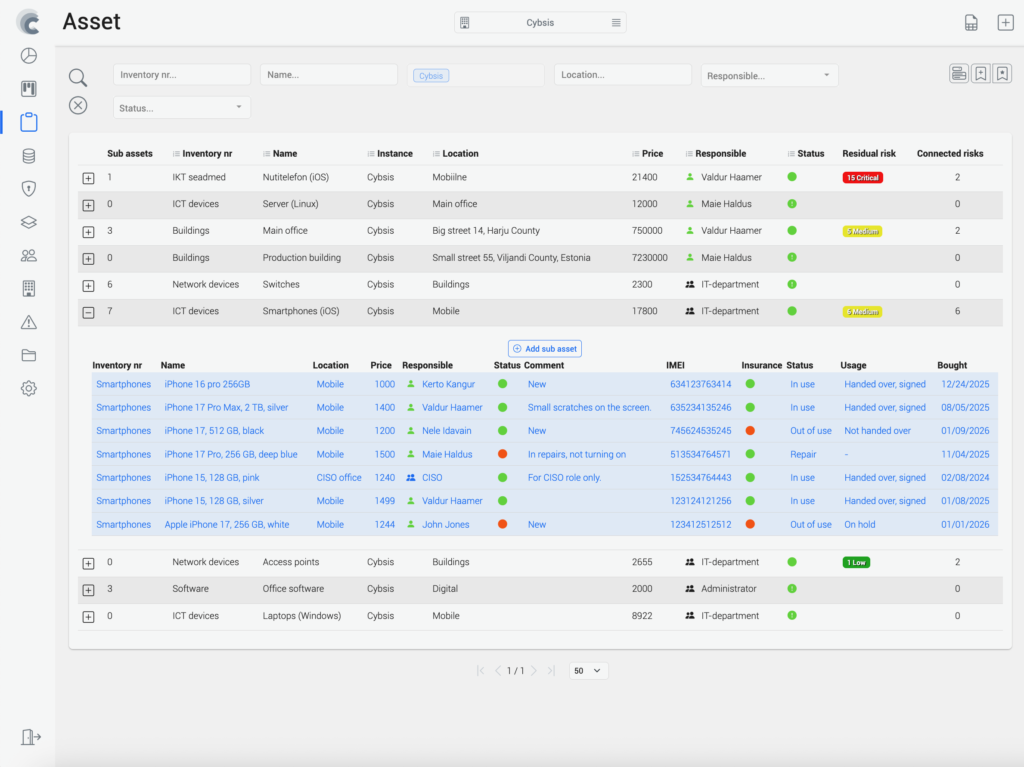
The asset management module in Cybsis forms the foundational layer of the entire information security management system, bringing together all organisational services, information systems, components, applications, servers, data collections, and processes into a unified structure.
The platform follows the E-ITS principles for asset inventory, assigning each asset an owner, criticality level, relationships with other assets, and links to relevant security measures. Cybsis makes asset mapping systematic and transparent, ensuring that the risk analysis, IMR, and audit readiness are all based on a complete and up-to-date overview of the organisation’s assets.
The asset management module helps the organisation understand precisely what needs protection, the dependencies involved, and the extent to which required security controls cover assets.
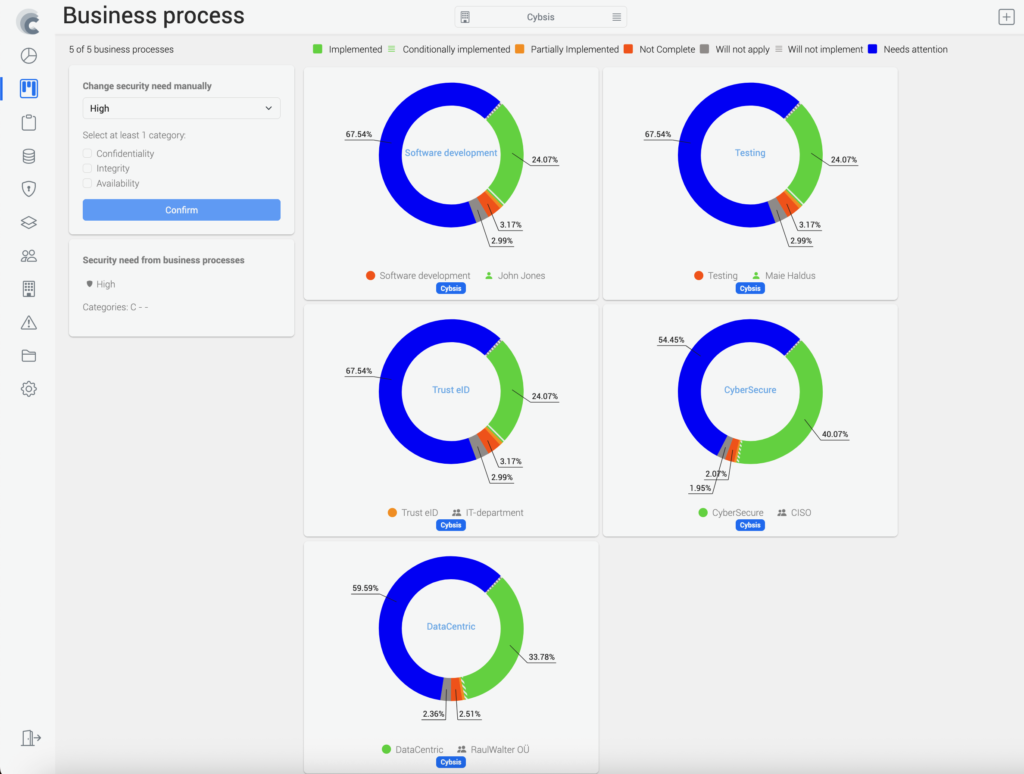
Cybsis supports business process mapping as an independent yet security-critical layer that connects organisational services, assets, and risks with real operational workflows. Business processes are documented together with their owners, inputs, outputs, related information systems, data repositories, and key components, creating a clear understanding of how the organisation’s core activities actually function. This forms the basis for risk assessment, control alignment, IMR development, and audit readiness.
Cybsis makes business process mapping systematic and transparent by automatically linking processes with assets, risks, and security measures. The result is an accurate and traceable view of business-critical processes that supports management decision-making and ensures that information security is fully integrated into daily operations.
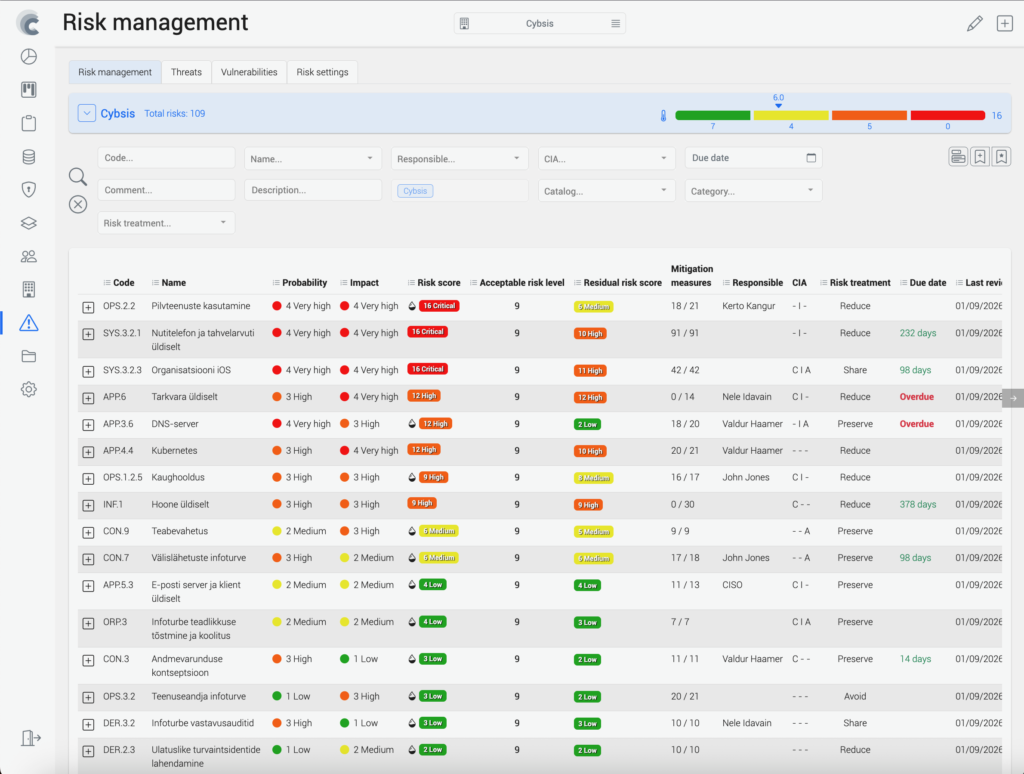
Cybsis fully supports the E-ITS risk analysis methodology, enabling organisations to identify, assess, and manage information security risks in a systematic and evidence-based manner. Risk scenarios are created in the platform based on assets, business processes, and identified vulnerabilities, followed by evaluating their likelihood and impact and calculating the associated risk levels. Risks are automatically linked to the relevant security measures and IMR activities, helping organisations set priorities and plan corrective actions.
Cybsis allows the risk register to be continuously updated, supports the management of control mechanisms, and provides senior management with a clear overview of the organisation’s risk profile. The result is a transparent, traceable, and fully auditable risk management process that forms the core workflow of E-ITS implementation.
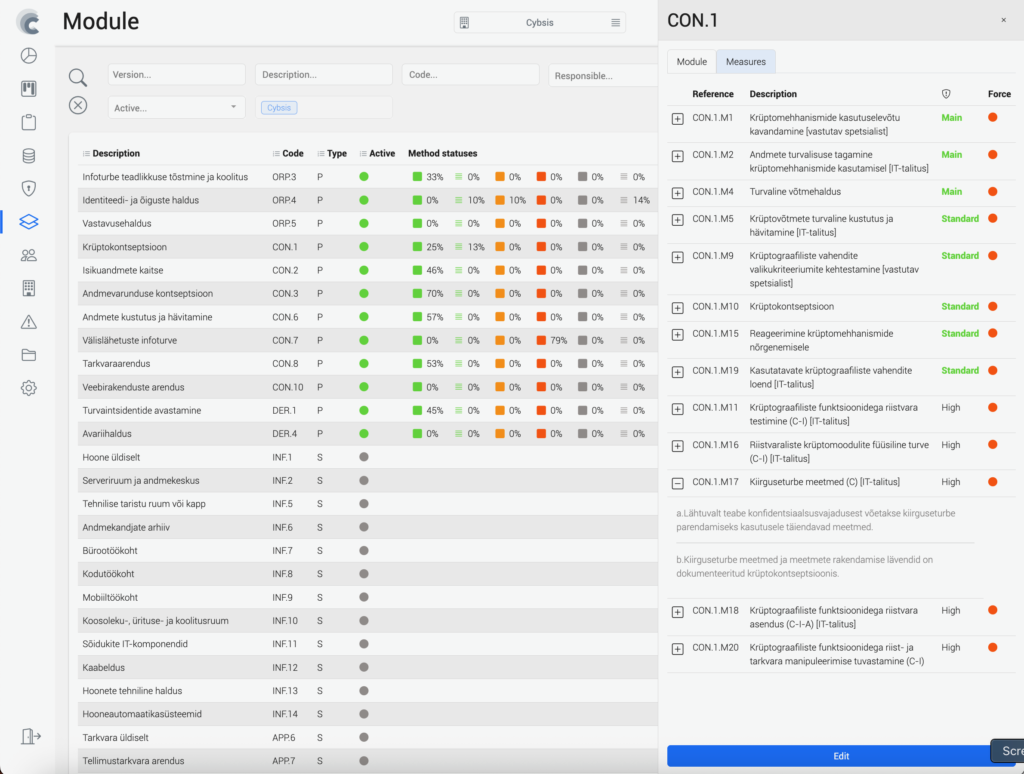
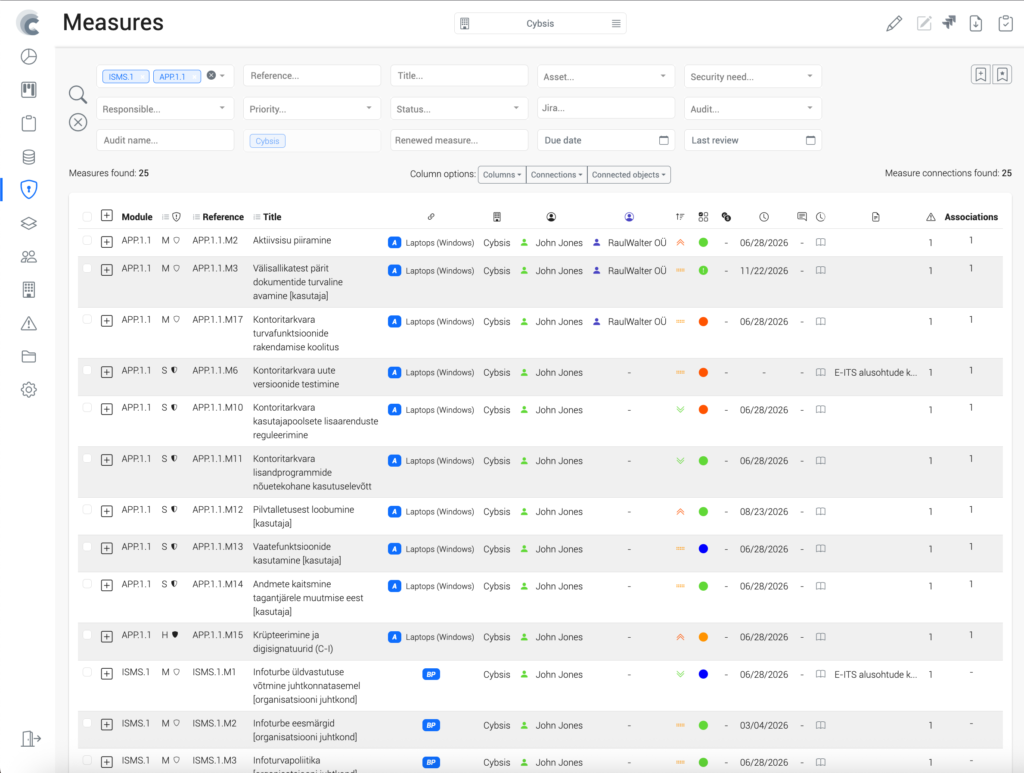
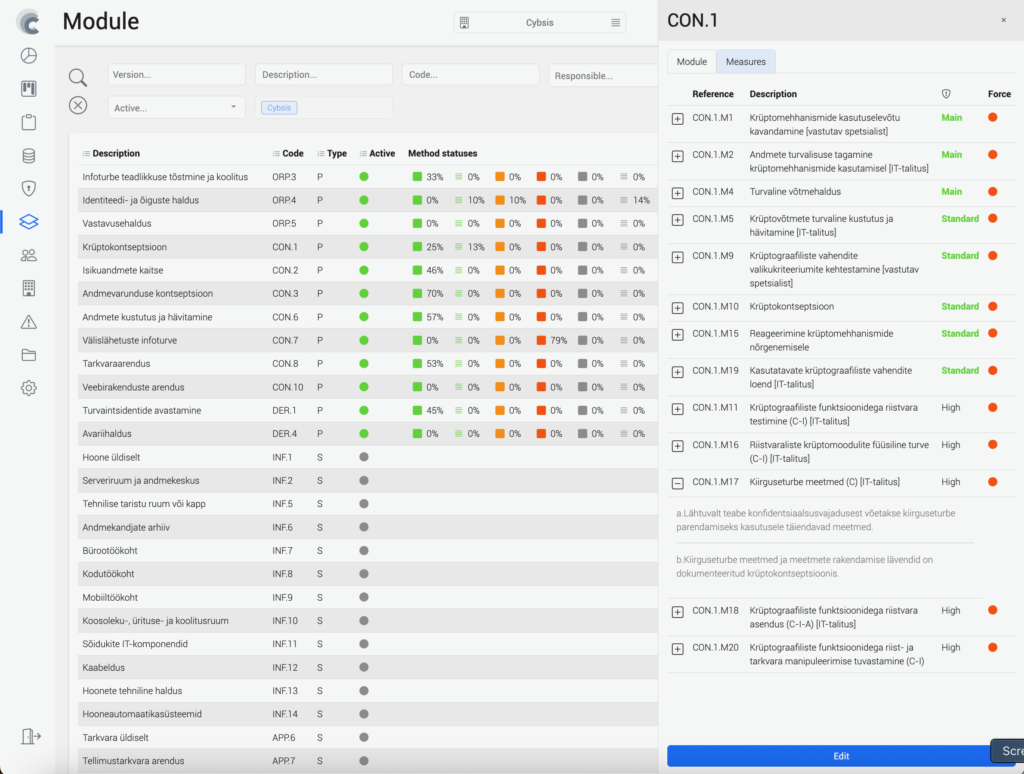
Cybsis supports the implementation of security measures in accordance with E-ITS requirements, linking each control to the relevant assets, risks, and organisational units. Every measure is documented with its objective, scope, responsible owner, validity period, and verification method, ensuring a clear overview of which requirements are already fulfilled and which still require attention.
Cybsis generates control-specific tasks, tracks implementation progress, and manages the evidence required for both internal and external audits. The platform implements systematic, transparent security measures, enabling organisations to transition from fragmented documentation to a unified, comprehensive, and controllable information security framework. The result is a clearly structured and fully auditable overview of the current status of security measure implementation.
The Cybsis IMR (Information Security Measures Implementation Plan) is a central tool for implementing E-ITS requirements, consolidating all security measures into a unified, structured, and time-bound action plan. The IMR links each measure with the corresponding risks, assets, and responsible owners, helping organisations set priorities, allocate resources, and define deadlines. The platform enables tracking implementation progress, managing deviations, adding evidence, and preparing audit packages for both internal and external audits.
The Cybsis IMR implements security measures that are transparent and controllable, reducing administrative overhead and ensuring that the organisation progresses systematically toward an E ITS–compliant security posture. The result is an operational and fully auditable corrective and implementation plan that supports the entire information security management system.
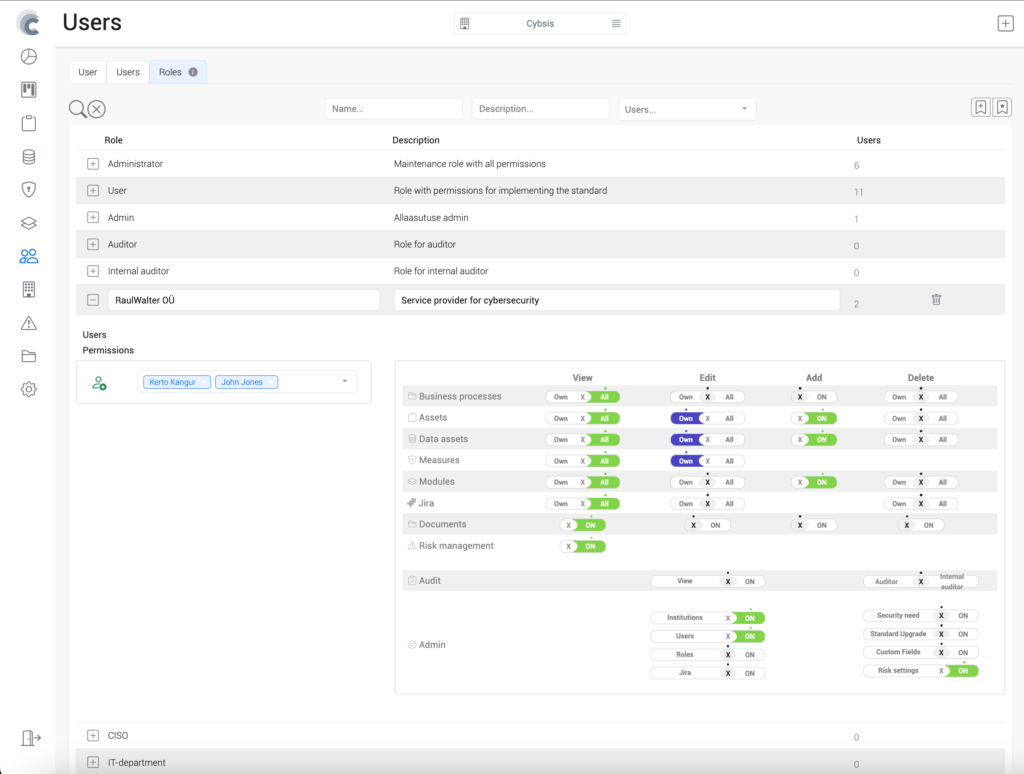
Cybsis provides clear and transparent task, role, and responsibility management across the entire information security management system. The platform allows organisations to assign responsible owners for assets, risks, and security measures; create tasks for implementing IMR activities; set deadlines; and track progress throughout the process.
Role-based access control ensures that each user can view and manage only the tasks within their area of responsibility, supporting the E-ITS requirement for clearly assigned ownership and accountability within information security processes. Cybsis consolidates all security-related activities into a single workflow, reducing fragmentation and ensuring that no critical task is overlooked. The result is a consistent, traceable, and fully auditable operational structure that supports a mature information security practice.
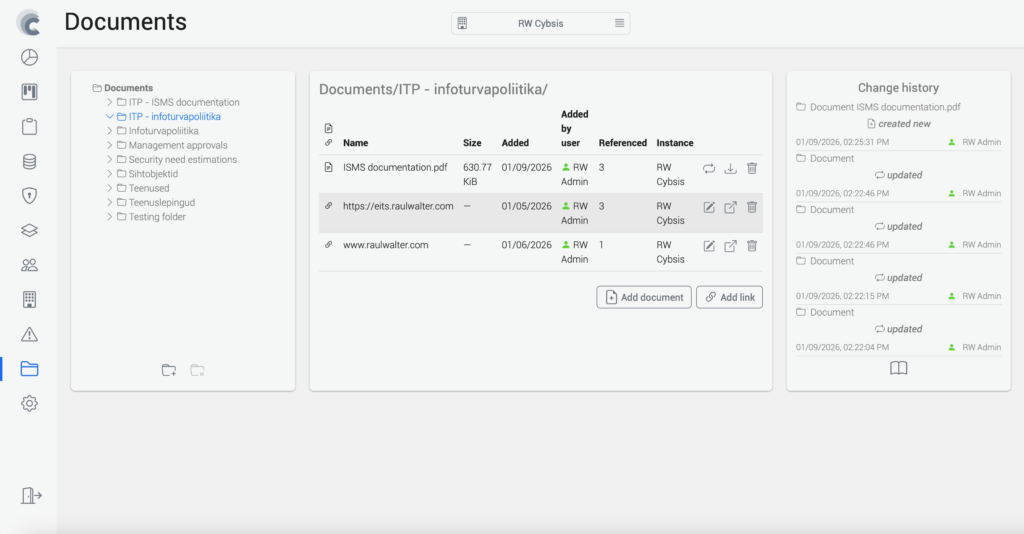
Cybsis centralises all policies, guidelines, procedures, logs, and audit evidence required for managing information security into a single, structured environment.
Each document and piece of evidence is linked to a specific security measure, asset, or IMR activity, ensuring a transparent, fully auditable connection between E-ITS requirements and the organisation’s operational practices.
The platform supports version control, validity reviews, and cyclical evidence updates, making audit preparation significantly faster and more accurate.
Cybsis ensures that all required evidence is always accessible, up to date, and associated with the correct control or measure, reducing administrative burden and increasing the reliability and maturity of the information security management system.
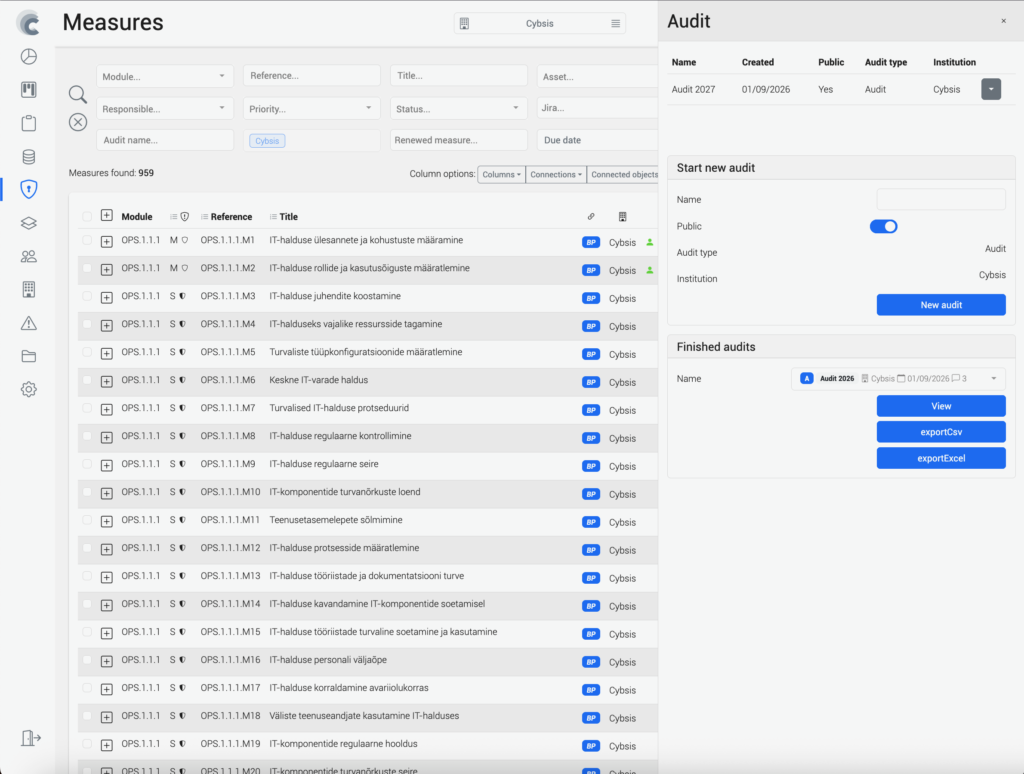
The Cybsis audit view consolidates all E-ITS requirements, security measures, evidence, and IMR activities into a single overview that displays the organisation’s compliance status in real time. The platform clearly presents fulfilled and unfulfilled requirements, nonconformities, risk areas, and all evidence needed for audit purposes in a structured format that supports both internal and external audits.
Cybsis tracks the progress of security measure implementation, the validity of documents and evidence, and automatically identifies gaps that may hinder compliance with E-ITS requirements. The audit view significantly reduces preparation time, making the audit process transparent, evidence based, and fully controllable. The result is a systematic and operational compliance overview that supports management decision-making and ensures that the organisation progresses consistently toward an E-ITS–compliant security posture.
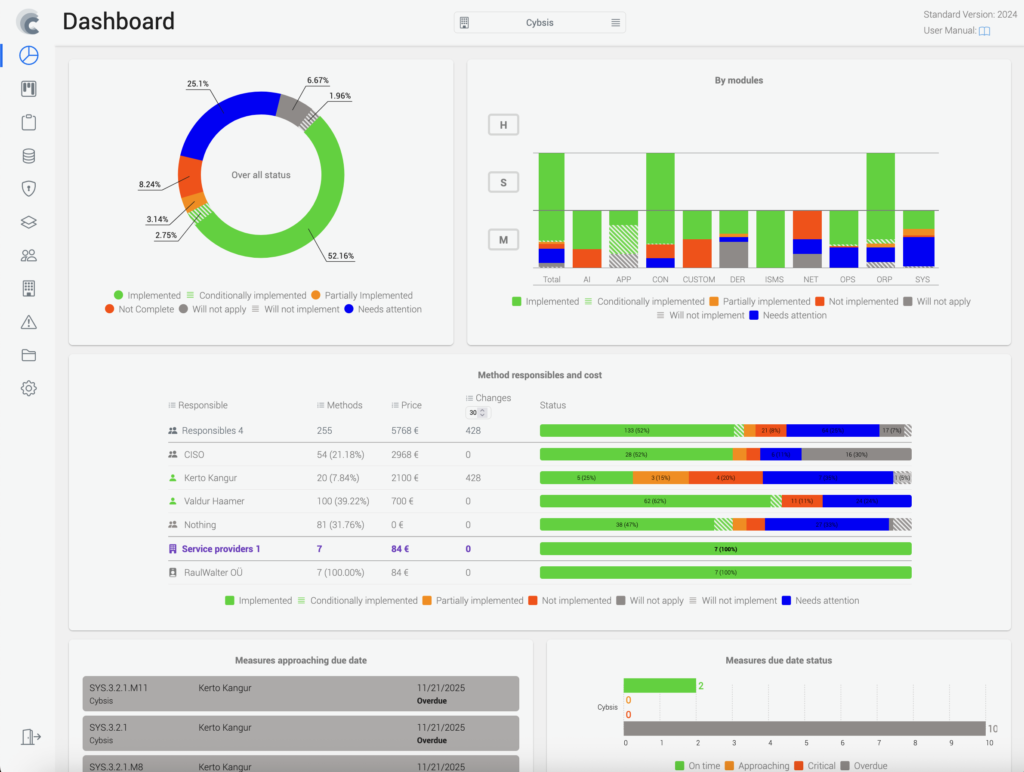
Cybsis provides management and the information security team with real-time visibility into the organisation’s security posture, risk exposure, and the progress of security measure implementation. The platform visualises critical indicators — unfulfilled requirements, risk scenarios, IMR progress, audit readiness, nonconformities, and asset protection levels — through clear and intuitive charts.
Cybsis enables the creation of automated management reports, periodic reviews, and domain-specific operational reports that support decision-making and resource planning. The dashboards consolidate all key indicators of the information security management system into a single view, making monitoring operational, transparent, and evidence-based. The result is a practical tool that helps management assess security maturity and direct necessary actions to the right place at the right time.
Cybsis supports a range of integrations that simplify user management, strengthen security, and streamline information security processes. The platform enables authentication using the Estonian ID card, ensuring strong cryptographic identity verification and transparent user traceability.
The Active Directory integration allows automatic synchronisation of users, roles, and organisational units, ensuring that permissions and responsibilities remain up to date and aligned with the organisation’s structure.
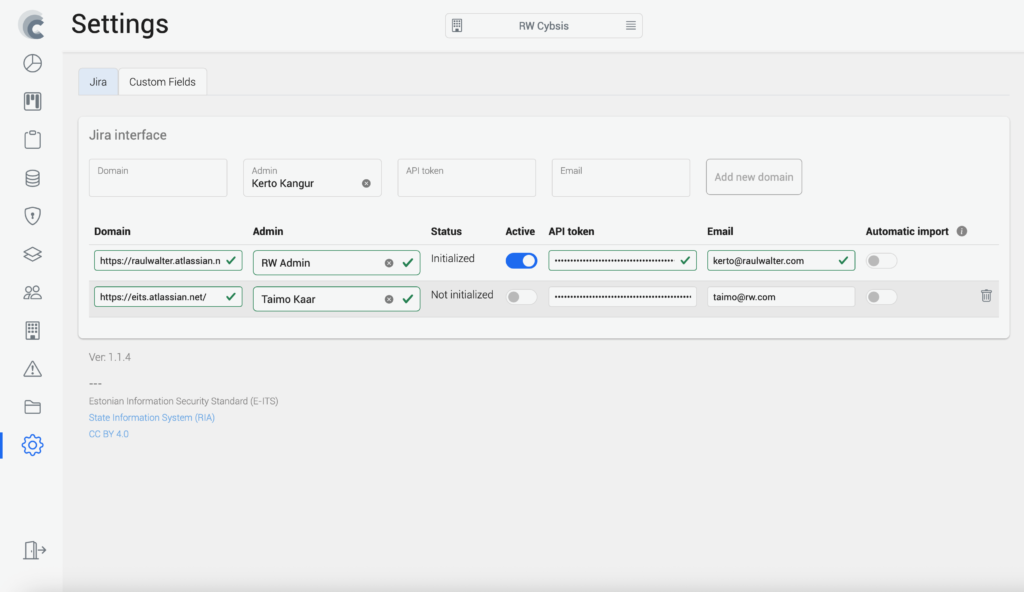
The Jira Cloud integration links information security tasks with the organisation’s overall workflow: IMR activities, risk-related tasks, and corrective actions from audit findings can be automatically forwarded to Jira, ensuring full traceability and reducing administrative overhead.
These integrations make Cybsis a natural part of the organisation’s technical and operational ecosystem, supporting security, efficiency, and process continuity.
To provide the best experiences, we use technologies like cookies to store and/or access device information. Consenting to these technologies will allow us to process data such as browsing behavior or unique IDs on this site. Not consenting or withdrawing consent, may adversely affect certain features and functions.
RaulWalter – Trusted Digital Infrastructure
We firmly believe that the internet should be available and accessible to anyone, and are committed to providing a website that is accessible to the widest possible audience, regardless of circumstance and ability.
To fulfill this, we aim to adhere as strictly as possible to the World Wide Web Consortium’s (W3C) Web Content Accessibility Guidelines 2.1 (WCAG 2.1) at the AA level. These guidelines explain how to make web content accessible to people with a wide array of disabilities. Complying with those guidelines helps us ensure that the website is accessible to all people: blind people, people with motor impairments, visual impairment, cognitive disabilities, and more.
This website utilizes various technologies that are meant to make it as accessible as possible at all times. We utilize an accessibility interface that allows persons with specific disabilities to adjust the website’s UI (user interface) and design it to their personal needs.
Additionally, the website utilizes an AI-based application that runs in the background and optimizes its accessibility level constantly. This application remediates the website’s HTML, adapts Its functionality and behavior for screen-readers used by the blind users, and for keyboard functions used by individuals with motor impairments.
If you’ve found a malfunction or have ideas for improvement, we’ll be happy to hear from you. You can reach out to the website’s operators by using the following email
Our website implements the ARIA attributes (Accessible Rich Internet Applications) technique, alongside various different behavioral changes, to ensure blind users visiting with screen-readers are able to read, comprehend, and enjoy the website’s functions. As soon as a user with a screen-reader enters your site, they immediately receive a prompt to enter the Screen-Reader Profile so they can browse and operate your site effectively. Here’s how our website covers some of the most important screen-reader requirements, alongside console screenshots of code examples:
Screen-reader optimization: we run a background process that learns the website’s components from top to bottom, to ensure ongoing compliance even when updating the website. In this process, we provide screen-readers with meaningful data using the ARIA set of attributes. For example, we provide accurate form labels; descriptions for actionable icons (social media icons, search icons, cart icons, etc.); validation guidance for form inputs; element roles such as buttons, menus, modal dialogues (popups), and others. Additionally, the background process scans all the website’s images and provides an accurate and meaningful image-object-recognition-based description as an ALT (alternate text) tag for images that are not described. It will also extract texts that are embedded within the image, using an OCR (optical character recognition) technology. To turn on screen-reader adjustments at any time, users need only to press the Alt+1 keyboard combination. Screen-reader users also get automatic announcements to turn the Screen-reader mode on as soon as they enter the website.
These adjustments are compatible with all popular screen readers, including JAWS and NVDA.
Keyboard navigation optimization: The background process also adjusts the website’s HTML, and adds various behaviors using JavaScript code to make the website operable by the keyboard. This includes the ability to navigate the website using the Tab and Shift+Tab keys, operate dropdowns with the arrow keys, close them with Esc, trigger buttons and links using the Enter key, navigate between radio and checkbox elements using the arrow keys, and fill them in with the Spacebar or Enter key.Additionally, keyboard users will find quick-navigation and content-skip menus, available at any time by clicking Alt+1, or as the first elements of the site while navigating with the keyboard. The background process also handles triggered popups by moving the keyboard focus towards them as soon as they appear, and not allow the focus drift outside it.
Users can also use shortcuts such as “M” (menus), “H” (headings), “F” (forms), “B” (buttons), and “G” (graphics) to jump to specific elements.
We aim to support the widest array of browsers and assistive technologies as possible, so our users can choose the best fitting tools for them, with as few limitations as possible. Therefore, we have worked very hard to be able to support all major systems that comprise over 95% of the user market share including Google Chrome, Mozilla Firefox, Apple Safari, Opera and Microsoft Edge, JAWS and NVDA (screen readers).
Despite our very best efforts to allow anybody to adjust the website to their needs. There may still be pages or sections that are not fully accessible, are in the process of becoming accessible, or are lacking an adequate technological solution to make them accessible. Still, we are continually improving our accessibility, adding, updating and improving its options and features, and developing and adopting new technologies. All this is meant to reach the optimal level of accessibility, following technological advancements. For any assistance, please reach out to